
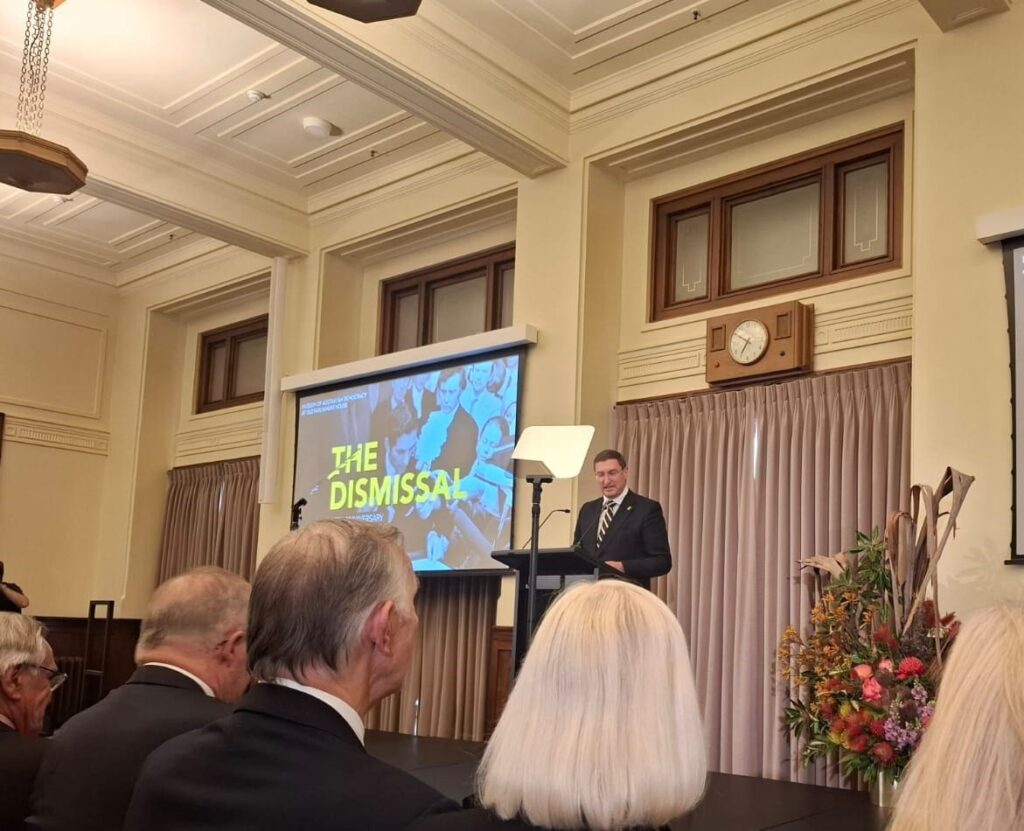
Tomorrow, we mark half a century since one of the signal events of Australian politics — the dismissal of Gough Whitlam by the Governor-General, Sir John Kerr.
That event is important for three reasons.
First, the event saw the constitutional resolution of Australia’s most acute political crisis.
Second, it marked the end of the revolutionary and chaotic Whitlam Government.
Finally, it was the beginning of the important but now little-celebrated government of Malcolm Fraser.
Fraser and Whitlam were huge political figures.
Whitlam Government
Gough Whitlam was the progressive-minded Sydney barrister — a man in a hurry — determined to leave a mark after 23 years of Labor being in the political wilderness. He was intelligent, witty and yet tragic — a man who modernised his party and was trying to modernise Australia — an operatic figure whose unorthodox approach ultimately brought him undone and left Australia with a financial burden that it took years to recover from.
Malcolm Fraser was an institutional conservative with a progressive liberal temperament.
As a politician, he was a tough-minded workaholic — a man who was principled and resolute, a man whose brinkmanship brought down two prime ministers.
A man whose actions in 1975 are still defended by the Liberal Party, even though Fraser became estranged from the Party and revised his position on many key issues he had previously championed while in office.
In the middle was the Governor-General, Sir John Kerr — a man with a Labor background, the son of a boilermaker, a protégé of Dr H. V. Evatt, a Fort Street graduate, a returned serviceman, a brilliant lawyer with a glittering academic record at Sydney University Law School; President of the NSW Bar, President of the Law Council of Australia, President of LawAsia, the father of the modern administrative law system, Chief Justice and Lieutenant-Governor of NSW, and Gough Whitlam’s choice for Governor-General.
A man who, through doing his duty, was vilified by the Labor Party, sections of the media and the broader Left.
A sample of this is in the words of Paul Keating, speaking in Parliament on the condolence motion for Sir John two days after he died. Keating said:
“The fact of the matter is that the Labor Party makes the political heroes in this country. When people cross the Labor Party they wear the crosses it puts on them, whether it be Billy Hughes or Joe Lyons — that is the truth of it. Sir John Kerr has worn the admonition of the Labor Party.”
Gough Whitlam came to government in 1972 after 23 years of Liberal governments. His government is remembered for a wide range of social reforms, including the Family Law Act, its policy on free university, and Medibank.
Not all of the reforms Whitlam is credited with are actually things his government did.
Donald Horne wrote in A Time of Home Australia 1966–1972 that “these seven years not the three Whitlam years were the time of critical change.”
For instance, the White Australia policy was ended by Harold Holt, it was John Gorton who established the Australian film industry, and it was Bill McMahon who stopped sending troops to Vietnam.
But for all Whitlam’s derring-do, his government was beset by a range of scandals and financial mismanagement.
The scandal which precipitated Malcolm Fraser’s decision to block supply was the Loans Affair — an attempt by the Whitlam Government to bypass the Loans Council and borrow billions of dollars for major resource projects such as a gas pipeline and a uranium enrichment plan.
The authority for these loans — described as being “for temporary purposes,” albeit with a term of 20 years — was pushed through the Executive Council in the absence of the Governor-General.
The credibility of these arrangements was undermined by the involvement of the colourful London-based commodities trader Tirath Khemlani as intermediary for the loan.
Khemlani was to be paid an outsized commission and yet was not forthcoming about the sources of the money or his actual ability to secure the loan, and Whitlam was repeatedly warned by officials that he was a conman.
But the relevant minister, Rex Connor, continued to seek loans from Khemlani even after his authority to do so was withdrawn.
This, then, was the background to the events of 1975.
The Constitution
Australia was very lucky with the generation of people who wrote our Constitution. The framers of the Australian Constitution were innovators. They were also practical and experienced parliamentarians.
In creating the Australian Federation, they borrowed the best ideas from around the world at the time — Britain, Canada, the United States, and Switzerland all provided models which informed the creation of a federal nation based on a written constitution. They drew on their experience of bicameral colonial parliaments which included, at times, obstructionist upper houses.
Federation was never a certainty. It involved parliamentarians giving up power to a new entity. It involved small states seeking protections from being subsumed by the power of larger states, and it involved larger states seeking to ensure that they were not held at the mercy of smaller states.
The Federation fathers sought to create two houses of Parliament — one to represent the people and the other to represent the states.
A strong Senate was the price for Federation.
They made the power of the Senate equal in every way to the House of Representatives, except that the Senate could not initiate or amend money bills.
They knew there would be conflict between the houses and established in s 57 the double dissolution — a unique mechanism for what to do when there is an impasse, which is triggered when the Senate repeatedly fails to pass a bill presented to it by the House of Representatives.
The Constitution itself is, of course, a sparse document. It is just 128 sections long. Core principles are given the most cursory treatment; the Prime Minister is not mentioned even though the “Governor-General” appears some 64 times.
The point is, of course, that the system of government created by the framers works because the Constitution speaks only where it must; it relies on the wisdom distilled through the centuries into the conventions that deliver a functioning government.
And in our case, the Constitution created a system of responsible government in which a Prime Minister who could not secure the confidence of the House of Representatives and supply from the Parliament had to resign or advise a general election. That was the issue in 1975.
Rebutting the criticisms of Kerr
The actions of Sir John Kerr in withdrawing Gough Whitlam’s commission have been criticised for three main reasons.
First, some Whitlam supporters dispute the convention that the Prime Minister should have to advise a general election because he cannot get his budget through the Senate.
At the time of the dismissal, Whitlam and others claimed that the Prime Minister is only responsible to the House of Representatives and that a Prime Minister who could maintain confidence in the House of Representatives could continue to govern.
There were claims of foul play about the Fraser Opposition’s tactic of blocking supply to force an election.
But this very same tactic had been unsuccessfully attempted by the Labor Party in the Senate on 170 occasions between 1950 and 1970 in order to block a budget and force the then Liberal government to an election.
Speaking in 1970, Opposition Leader Gough Whitlam said:
“The Labor Party believes that … Any Government which is defeated by the Parliament on a major taxation Bill should resign… This Bill will be defeated in another place. The Government should then resign.”
And later:
“Let me make it clear at the outset that our opposition to this Budget is no mere formality. We intend to press our opposition by all available means on all related measures in both Houses … we will vote against the Bills here and in the Senate. Our purpose is to destroy this Budget and to destroy the Government which has sponsored it.”
That was the Labor Party position on the blocking of supply, and the consequences that should follow, before 1975.
Second, the Chief Justice of Australia, Sir Garfield Barwick, was criticised by Whitlam and his supporters for advising Sir John Kerr about the exercise of his powers, and it was suggested that this was somehow unprecedented or improper.
But Chief Justices Sir Samuel Griffith and Barwick’s immediate predecessor, Sir Owen Dixon, had advised Governors-General about their exercise of the reserve powers as well.
Barwick himself had advised Lord Casey about the exercise of his reserve powers following the disappearance of Harold Holt in 1967.
And in 1951, the Labor Party called on Governor-General Sir William McKell to consult with Chief Justice Latham before granting a double dissolution to Sir Robert Menzies.
Other justices were also consulted about the exercise of reserve power — including Sir Edmund Barton and, in 1975, Sir Anthony Mason.
The views espoused by Barwick and the actions of Sir John Kerr were widely endorsed in legal circles at the time by former High Court Justice Sir Victor Windeyer and future High Court Chief Justice Murray Gleeson, future High Court Judge Sir Keith Aickin, former Solicitor-General Bob Ellicott, the Shadow Attorney-General, and the Canadian socialist and convention expert Eugene Forsey, and many other academic and legal commentators.
Third, the criticism is made that Whitlam was surprised, and should have been warned that the Governor-General was going to dismiss him.
Whitlam was well aware of the fact that Kerr could dismiss him.
At a State Dinner at Government House in October 1975 with Tun Abdul Razak, the then Prime Minister of Malaysia, when asked by Razak about how the crisis might be resolved, Whitlam told Razak and Kerr that it might end up being a case of “who gets to the palace first.”
At a press conference on the afternoon of the dismissal, Whitlam was asked if the Governor-General misled him. Whitlam said, “No, I wouldn’t say that.”
Whitlam had flagged with the Governor-General earlier in the day that he would be coming to advise a half-Senate election.
When Whitlam came to Government House, Kerr asked him if he intended to continue to govern without supply. Whitlam said he did. Kerr then said Whitlam could not continue to govern without supply and that Kerr would withdraw Whitlam’s commission.
At that point, Whitlam could have discussed the issues with Kerr and negotiated to call a general election with Whitlam remaining as Prime Minister, but instead Whitlam said, “I must get in touch with the Palace at once” — in other words, to get Kerr sacked.
At this point, Kerr gave him his letter of termination and statement of reasons.
Sir John Kerr’s job was to execute and maintain the Constitution under s 61.
In this instance, where a Prime Minister could not get his budget bills through the Parliament, and where government departments were running out of money to pay public servants and honour contracts, Kerr’s duty was to allow the Australian people to break the deadlock and be the final arbiters of the political crisis at the ballot box.
If Kerr had granted Whitlam’s request for a half-Senate election, this would not have broken the impasse. The new senators could not have taken their seats until July 1976 — many months later — and, if the 1975 election is a guide to the likely outcome, the result would have left Labor being in a worse position in the Senate in any event. None of this would have allowed supply to flow.
Logistically, 13 December was the last possible date to have an election before the summer break, when, by Mr Whitlam’s own admission, the government was running out of money.
The Governor-General’s actions in 1975 were not a “coup,” as some on the political left have claimed. A coup is where someone seeks to hold power for themselves, often at the hands of the military, and refuses to relinquish that power.
What Kerr did was to be the guardian of the Constitution and to break a political impasse by letting the Australian people have the ultimate say.
1975 election
Australians had the opportunity to reject the actions of Sir John Kerr. In fact, this was the central theme of Whitlam’s campaign.
But when given the choice, the Australian people overwhelmingly endorsed the actions of Sir John Kerr and elected Malcolm Fraser’s government in an historic landslide.
At the election on 13 December 1975, the Coalition secured a 7.3% swing against Labor. Labor lost 29 seats, leaving the Coalition with 91 of 127 House seats — a 55-seat majority, more than 53 per cent of the primary vote and nearly 56 per cent of the two-party-preferred vote.
Labor’s representation was almost halved.
In the Senate, the Coalition increased its majority to 35 Coalition to 27 Labor, with two independents.
To that point, the 1975 election produced the largest majority for a government in the history of Australia.
This was not a tacit endorsement of the actions of Sir John Kerr; it was a thumping victory with control of both houses.
The election was a resounding endorsement of Sir John Kerr’s decision by the Australian people.
Whitlam years drama
The drama of the Whitlam years had taken its toll and left Australia in a weakened economic position.
The drama of the dismissal sat atop something deeper: an economy straining under the aftermath of the oil shocks, reckless spending decisions, surging inflation and rising unemployment.
During the Whitlam years, inflation rose by around 19 per cent, the highest since the early 1950s; productivity fell; unemployment climbed to 300,000; and business investment slumped.
Families were tired and anxious.
Confidence in the competence of the Whitlam Government had been shaken, and Australians were looking for a steady hand to get the country back on track.
Malcolm Fraser offered that steadiness. He offered to “turn on the lights” for Australia.
He sought a mandate to restore orthodox government, to repair the nation’s finances, to respect institutions and to lower the political temperature — to “take politics off the front page,” in his words.
The achievements of the Fraser governments continue to be felt to this day.
On the institutional front, Fraser made significant changes to introduce discipline to the Budget process. It was the Fraser Government that introduced the precursors to the Expenditure Review Committee to curb budget growth. It was the Fraser Government that moved to medium-term expenditure planning as the forerunner of modern “forward estimates budgeting,” allowing Treasury to project future spending levels and restrain undisciplined ad hoc expansion. These continue to be a feature of our budget processes today.
In terms of investment, productivity and support for private industry, it was the Fraser Government that created the Department of Productivity, provided tax incentives for energy exploration and secondary industry research and development, and supported the North-West Shelf gas project — at the time the single largest non-government project ever undertaken in Australian history and comparable in its scope to the Snowy Hydro scheme.
In terms of macro-economic policy, Fraser succeeded in halving inflation from its levels under Whitlam and commissioned the pivotal Campbell Committee of Inquiry into the Australian Financial System — which recommended floating the dollar, deregulating the banks and opening capital markets — reforms which were subsequently implemented in the Hawke/Keating years with Liberal support.
Crucially, with the economy coming under control, the Fraser Government was able to usher in a period of social and legal reforms.
He introduced a new system of family allowances that provided direct, practical help to mothers and families; created supplements for low-income households; and simplified pension arrangements with cleaner income testing and automatic indexation so that Australians on fixed incomes were not left behind by inflation.
He extended support to single parents, established the Office of Child Care and signalled that strong families and opportunity for children were central obligations of government, not afterthoughts.
He reformed Australia’s legal institutions — establishing the Federal Court and the Commonwealth Ombudsman, and the Freedom of Information Act.
A process of New Federalism was undertaken to revitalise relations between the Commonwealth and the States.
The Northern Territory and Norfolk Island were given self-government, and constitutional reform was implemented through successful referenda.
Indeed, of the eight successful referenda that have re-shaped our constitutional framework, seven were put forward by the Liberal Party. And three of those successful referendums were passed in a single day in May 1977 — dealing with Senate casual vacancies, counting the votes of Territorians in referenda, and the retirement of judges.
On the same day, at a plebiscite, Advance Australia Fair was chosen as our national song.
Fraser abhorred racial intolerance at home and abroad and sought to create a cohesive multicultural country.
He established the Australian Institute of Multicultural Affairs and reframed settlement policy through the Galbally Report.
He established the National Aboriginal Conference to hear from the voices of Indigenous leaders.
He created the Northern Territory Land Rights Act and established the Aboriginal Development Commission to provide housing and infrastructure for Aboriginal communities.
He was a leading voice internationally against apartheid. His government established commercial FM radio and laid the foundations for much of our current sporting success by establishing the Australian Institute of Sport in 1981.
Conclusion
Tomorrow is an important day in the history of our institutions, our organs of government, and our country.
It is a day that deserves remembrance in three parts.
We should remember the Whitlam Government — its achievements, but also the upheaval that characterised that period.
We should remember the drama of the dismissal itself, a watershed moment in our political, legal and constitutional history. And we should remember the steadiness that followed: the reforming Fraser Government, which helped rebuild trust in our institutions and the democratic processes that follow.